Deregistering a Dutch vehicle for export: who receives which document
When a vehicle leaves the Dutch register for export, three papers matter: an export certificate, a registration card with a cut corner and a proof of deregistration. Here is who receives which, what happens to the yellow plates and whose name is used.
- Export document from €50
- Seller receives proof of deregistration
- Papers by post, insured and tracked
from €50
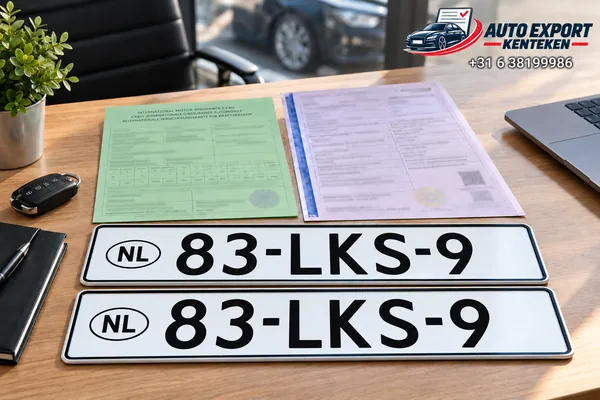
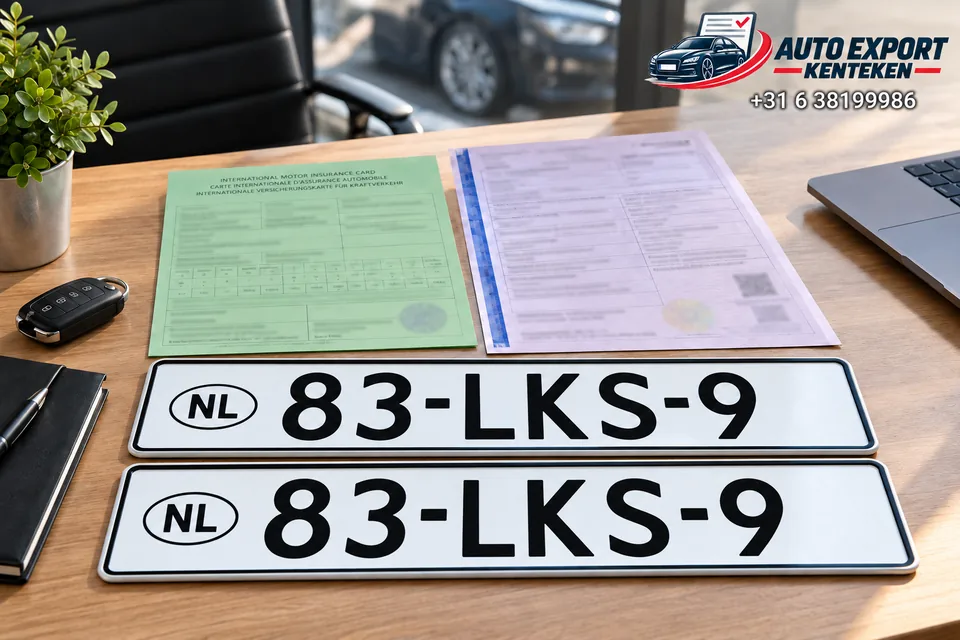
Deregistering a vehicle for export means taking it out of the Dutch vehicle register because it is leaving the country. At our RDW-recognised export desk in Hengelo we process the deregistration, take in the yellow plates and issue the papers. If the vehicle goes on its own wheels, it also gets white plates and temporary insurance.
Each party leaves with different papers. Knowing which one you need, and in whose name, prevents problems at registration later.
What deregistration for export means
Once the deregistration is processed, the vehicle no longer has a normal Dutch registration. According to the RDW (the Dutch vehicle authority), the Dutch owner's obligations to insure the vehicle, keep the APK (the Dutch periodic roadworthiness test) valid and pay road tax then stop. If the vehicle is driven out of the country, it uses the export kenteken: its existing number on white plates, for 14 days on Dutch public roads and never longer than the APK.
The RDW advises not to deregister until you know which documents the destination country asks for. The export document, from €50, covers the deregistration, the export certificate, the proof of deregistration and the RDW processing.
The export certificate for the buyer
The person in whose name the export is arranged receives the kentekenbewijs deel II, the Dutch export certificate, together with the kentekencard (the Dutch registration card) with one corner cut off. With the old paper registration documents, you get the tenaamstellingsbewijs deel 1B (part 1B of the old paper registration) back instead of a card. These are the documents needed for registration in the new country, so keep the originals safe.
The RDW notes that the name of whoever arranges the export appears on the export certificate. A company name on the export certificate is only possible when the export is done at an RDW location, not at a recognised company like ours.
The proof of deregistration for the seller
The seller receives the vrijwaringsbewijs: the proof that the Dutch registration has ended. When a car is sold to a buyer abroad, it is not first transferred to the buyer in the Dutch register. The RDW tells sellers to make sure the buyer exports the vehicle in the buyer's own name; the buyer then receives the export certificate and the seller the proof of deregistration.
A seller who arranges the export in their own name stays responsible for the vehicle, according to the RDW, until it is registered abroad. Foreign buyers can read the steps from their side in our guide to buying a car in the Netherlands.
Handing in the yellow plates at the export desk
The yellow Dutch plates are handed in at the export. If they are missing, new plates have to be made first by a recognised number plate manufacturer. Buying a car to export? Agree with the seller that the yellow plates come with it, because they have to be handed in. For the drive, the vehicle gets white export plates: two for a car, one for a motorcycle, scooter, moped, caravan or trailer.
Papers to bring for the export deregistration
Checklist
- Valid passport, ID card or driving licence of the person the export is registered to
- The Dutch registration card (kentekencard) with its registration code (tenaamstellingscode), or the old paper parts (part 1B and the transfer certificate)
- The Dutch yellow number plates (one plate for a motorcycle, scooter, moped, caravan or trailer)
- The current mileage
- The full foreign address of the buyer or new owner
- For insurance and plates: start date, destination and route, plus details of the policyholder and the driver
Source: RDW. For a business buyer we also need the company name, address and VAT number.
With complete papers, a standard application at the desk is usually ready in about 15 minutes. The full order of events is described in how to apply for Dutch export plates.
Deregistering for export by post or from abroad
The yellow plates can also reach us by post or courier, and we start once they have arrived. We send the documents back insured and with tracking, to an address in the Netherlands or abroad.
Is the vehicle already outside the Netherlands? Then we can arrange the export with the kentekenbewijs deel II entirely remotely, by post: DHL standard takes around 5 working days, DHL Express around 1 working day. Contact us first, before sending anything.
Export documents and the BPM refund
BPM is the Dutch purchase tax on cars. After an export, the Belastingdienst (the Dutch tax administration) can sometimes refund part of it, under its own conditions. We can prepare that request for you as a separate service, alongside the export document; see our page on the BPM refund on export.
| Service | Included | From |
|---|---|---|
| Export document | Export certificate, vrijwaringsbewijs (indemnification certificate) and RDW processing | €50 |
| Export insurance + white plates | 14 days liability cover, Green Card and white export plates | €100 |
| Complete export package | Export document, vrijwaringsbewijs, 14 days liability cover, Green Card and plates | €150 |
| Export insurance extension | 14 extra days of liability cover with a Green Card, requested online (per 14 days) | €120 |
When can the price be higher?
- All amounts are starting prices, including VAT where applicable.
- A surcharge may apply outside office hours. Office hours: Monday to Saturday 10:00 to 16:30. On Sundays you are welcome by appointment, at a higher rate; call or WhatsApp first for the final price.
- Postal delivery costs more; the same postal rate applies to the Netherlands and abroad.
- The price can differ per vehicle, for example for heavy or non-standard vehicles.
- You always know the price in advance.
All rates, including postal delivery, caravans, trailers and custom work, are on the page Cost of Dutch export plates.
Need Dutch export plates today?
Call or message us for free advice or an appointment, also outside office hours. On Sundays a higher rate applies; you always know the price in advance.
Export certificate and deregistration: questions
What exactly is a kentekenbewijs deel II, and who gets it?
It is the Dutch export certificate, issued in the name of the person who arranges the export. Together with the registration card with the cut corner, it is what you need to register the vehicle in another country.
Do I keep my registration card after the export?
Yes. You get the kentekencard (the Dutch registration card) back with one corner cut off. Keep it safe: you need it together with the export certificate for the registration abroad.
Can my company's name go on the export certificate?
Only if the export is done at an RDW location. We are an RDW-recognised export company, not an RDW location, so if you need the company name on the export certificate, choose an RDW location.
When do insurance, APK and road tax stop for the Dutch owner?
According to the RDW, after the export deregistration the Dutch owner no longer has to insure the vehicle, keep the APK up to date or pay road tax for it.
Can I deregister now and decide on the destination later?
The RDW advises against it: do not deregister for export until you know which documents the destination country requires. Find that out first, then come to the desk.
RDW sources on deregistering for export
- RDW: Exporting a vehicle
- RDW: Voertuig naar buitenland: kenteken stopzetten
- RDW: Soorten kentekenplaten
Checked on 6 November 2026